Normalizing mixed-order tree traversal into pre-order traversal
Intro
While working on some parsing problems, I encountered an interesting problem that I haven't seen elsewhere and want to share it (with its solution).
When parsing, we often deal with parse tree traversals. Normally, the pre-order traversal is most convenient for processing, but parsers often don't produce parse results in that order.
Let's define a mixed traversal as a sequence of the following kinds of steps (one might also call them events):
- StartNode(payload): marks the start of a new node
- EndNode: marks the end of a previously started node (in LIFO order)
- WrapSiblings(payload, n): denotes the start of a new node, which has actually started before, specifically before the
n-th last node
payload is an information necessary to create a node, e.g. its type.
The sequence is processed left-to-right, and the tree is built incrementally, using a stack of nodes:
- StartNode(payload) pushes a new empty node into the stack
- EndNode pops a node from the stack and appends it into parent's children
- WrapSiblings(payload, n) creates and pushes a new node (just as StartNode), but “steals” n nodes from the current parent node and inserts them into a new node.
- This a similar to the “reduce” operation in LR parsing (except that “reduce” completes the node, while WrapSiblings leaves the node open for further modifications).
The “mixed” traversal is a superset of how different kinds of parsing algorithms construct a parse tree:
- LL parsers only use StartNode and EndNode;
- LR parsers only use WrapSiblings and EndNode;
- Pratt parsers emit all kinds of steps.
The problem is as follows: Given a sequence of steps corresponding to a mixed traversal, produce a sequence of steps corresponding to an equivalent pre-order traversal.
Example
Let's consider the following syntax tree that corresponds to a * b + c:
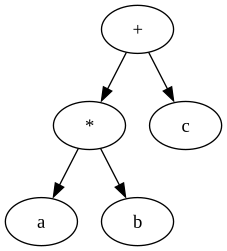
The pre-order traversal (top-down, left-to-right; which is what we want to ideally have) of this tree would be:
Start "+"
Start "*"
Start "a"
End
Start "b"
End
Start "c"
End
End
The bottom-up, left-to-right traversal would be (e.g., how an LR parser would process the string):
Start "a"
End
Start "b"
End
WrapSiblings "*" 2
End
Start "c"
End
WrapSiblings "+" 2
End
The other option for the traversal is (e.g., how a Pratt parser would process the string):
Start "a"
End
WrapSiblings "*" 1
Start "b"
End
End
WrapSiblings "+" 1
Start "c"
End
End
Naive baseline algorithm
The simplest algorithm is as follows:
- Allocate a stack
Sof active nodes. Initially,Scontains a sentinel virtual root. Each node inShasidandchildren, wherechildrenis a vector of nodes. - Iterate over the input sequence of steps and check each step:
- If it is
StartNode: create a new node and push it intoS. - If it is
EndNode: pop a node fromS, and push it intochildrenof the new top node of the stackS. - If it is
WrapSiblings(n): take lastnitems fromchildrenof the top node ofS, create a new node with thosenitems, and push it intoS.
- If it is
- At the end, serialize the resulting
Rinto events by a pre-order traversal of trees inR.
This algorithm is fine. It has a run time O(|input|), but it performs dynamic memory-allocations for individual nodes and has to allocate the whole tree.
A more efficient algorithm
Some observations
- When observing traversal left-to-right, we don't know if
WrapSiblingscomes in later and changes the tree structure. On the other hand, when processing it right-to-left, the structure we already emitted can'be affected by not-yet-processed events. - When processing steps right-to-left,
WrapSiblings(n)means “after emittingnnodes, emitStartNode”. - All active
StartNodeandWrapSiblings(i.e., for which the correspondingEndNodewas not yet observed in left-to-right order) belong to different tree levels. - Consecutive
WrapSiblingssteps may stack within each other, and their emit order may be reversed to their observation order. - Each node produced by a (
StartNode,EndNode) pair may be wrapped by multipleWrapSiblingsevents, i.e. one node can count towards siblings counts of multipleWrapSiblingsevents.
Algorithm, v0
The algorithm normalizes the sequence using a right-to-left scan of input sequence. It uses a stack as an auxiliary data structure to track information about active events at each tree level.
- Given:
S[n]- an array of tree traversal steps (as defined previously)
- Output:
O[n]- an array that holds elements of the same type asS(but only items of typesStartNodeandEndNodemay appear).
- Initialize:
L: array of Option<{ payload, num_nodes }>- growable array of that tracks for each tree depth level a currently activeWrapSiblings(i.e., which was observed but which is still waiting for one or more nodes before it can be emitted);Lis initially empty and may contain empty slots.payloadis the payload that should be emitted as a part of an equivalentStartNode(payload)num_nodesis the counter of remaining nodes beforeWrapSiblingscan be converted intoStartNode
O = []
- Steps:
- for
istarting fromn - 1down to0:- match on
S[i]:EndNode:- push
nullintoS - output
EndNodeintoO
- push
WrapSiblings { payload, num_nodes }:- find
k- the index of the lastnullvalue inL. Suchkshould always exist for a valid input sequence. Use simple linear search to findk. - assign
{ payload = S[i].payload, num_nodes = S[i].num_nodes }intoL[k]
- find
StartNode { payload }:- output
StartNode { payload }intoO - assert that
Lis not empty and it last value is an empty slot. This holds true for all valid input sequences. - pop the empty slot from
L - process pending
WrapSiblingsthat have been completed after emittingStartNode:- initialize
num_emitted = 1. This variable tracks the number of node we have emitted in this iteration. - for
jfromlength(L) - 1down to0:- if
L[j]is empty: break the for loop - assert that
L[j].num_nodes >= num_emitted. This holds true for all valid input sequences. - if
L[j].num_nodes = num_emitted:- output
StartNode { payload = L[j].payload }intoO - assert that
j = length(L) - 1. This holds for all valid input sequences - pop
L[j]fromL - increment
num_emitted
- output
- else:
- decrement
L[j].num_nodesbynum_emitted
- decrement
- if
- initialize
- output
- match on
- assert that
Lis empty. This holds true for all valid input sequences. - reverse
O
- for
The tricky part of the algorithm is the properly considering stacking of active WrapSiblings:
WrapSiblingsare emitted in reverse order, therefore they are added to a stack of level in reverse order (i.e., by looking for a free slot) as well- a node could have been at some point a child of several consecutive
WrapSiblingssteps, andWrapSiblingscould also be a child of another node produced byWrapSiblings. As a result of this, when processing events right-to-left, a completedStartNode(including the one produced by completing aWrapSiblings) leads to a decrement ofnum_nodesfor all consecutive slots ofL.
This algorithm runs in O(n * d) time and uses O(n + d) additional memory, where d is the depth of the tree. In the worst case, d is proportional N, and the runtime of this algorithm may degenerate to O(n^2).
This algorithm can be improved by several simple mechanical optimizations.
Optimization 1: pre-subtract L[j].num_nodes
Each consecutively stacked WrapSiblings must fully exhaust its num_nodes before the next one can be completed. Therefore we can decrement num_nodes of stacked WrapSiblings in advance, in which case each processed StartNode will only require a single decrement. At the same time we must also consider that completing a pending WrapSiblings produces StartNode event, which also result in further decrements of num_nodes on further levels. The overall result of this is that we need to pre-subtract num_nodes - 1 from each consecutiely-stacked WrapSiblings.
Optimization 2: in-place output
We may observe that the output of the algorithm fits into an already-visited part of the input array S.
And since the structure of the output is the same, we can reuse the input as an output and modify it in-place.
This lets us avoid O(n) of additional memory allocation, but does not change the runtime.
Optimization 3: track unoccipied tree levels in L
Searching for k - a pointer to a free slot in L - is O(d), but it can be made O(1).
The search can be optimized, if we consider that L operates in almost (but not quite) a stack-like fashion, as all reads and writes are happening at the end of L.
In addition to L, maintain F: array of { slot_idx, sum_num_nodes_sub_1 } - a stack of indices of all free slots in L. This data structure would let us quickly find the last free slot in L.
Each item of F contains 2 attributes:
slot_idx- index inLof the free slot;sum_num_nodes_sub_1- sum of(num_nodes - 1)of all occupied slots until the next free slot.
This stack is maintained and used in the following way:
- When pushing a new free level into
L, push{ slot_idx: level_idx, sum_num_nodes_sub_1: 0}intoF - When popping an empty slot from
L:- pop the value from
F
- pop the value from
- When popping a non-empty value from
L:- assert that its
num_nodesequals 1 - do nothing, as subtracting
num_nodes - 1 = 1 - 1 = 0does not change the value ofsum_num_nodes_sub_1
- assert that its
- When writing a value
vinto an empty slot ofL:- if
Fonly has 1 value: pop the value - if
Fhas 2 or more values: merge the last 2 values inF, taking into accountv.num_nodes - 1. I.e.:- pop
afromF - pop
bfromF - push
{ slot_idx: b.slot_idx, sum_num_nodes_sub_1 = a.sum_num_nodes_sub_1 + b.sum_num_nodes_sub_1 + v.num_nodes - 1 }
- pop
- if
- When searching for the last free slot in
L:- inspect the last value of
F; itsslot_idxis the last free slot index (i.e.,kin the base algorithm), and itssum_num_nodes_sub_1is the sum of(num_nodes - 1)for the remaining non-empty slots (i.e., equals torin the base algorithm)
- inspect the last value of
With these optimizations, the algorithm runs in O(n) time with O(d) additional memory.
Source code
Source code is available at https://codeberg.org/dmitryvk/convert-mixed-order-traversal. It contains the algorithm, as well as benchmarks and tests.